
Why Motorcycle TPMS Reliability Matters
Motorcycle TPMS needs to do more than display tire pressure and temperature. For brands developing a connected product or branded app, the sensors must provide reliable BLE data, clear alert behavior, and a practical rider experience under real riding conditions.
For riders, pressure and temperature monitoring can provide earlier warning of slow pressure loss or abnormal changes. For brands and distributors, unstable connections, confusing alerts, unclear battery behavior, or difficult pairing can quickly lead to support requests, returns, and negative reviews.
For general tire-pressure safety context, the NHTSA TireWise guidance explains how underinflation and temperature changes can affect tire pressure and warning behavior.
The objective is therefore practical: select a motorcycle TPMS platform that can be validated with the target app, documented clearly for integration, and reproduced consistently from samples through volume production.
Common Problems in Motorcycle TPMS Programs
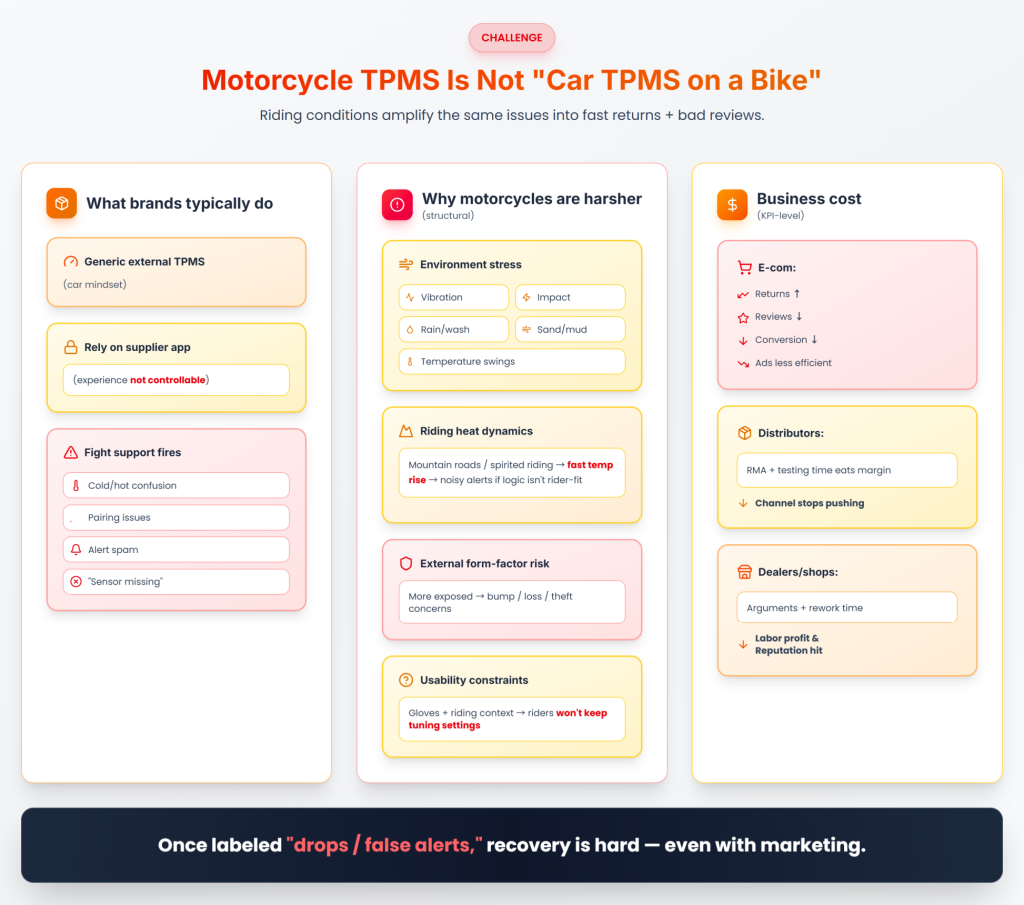
why motorcycle TPMS goes wrong (and why it hurts listings fast)
What brands typically do
- Use a “generic external TPMS” designed with a car mindset
- Rely on a supplier app (experience not controllable, user data not yours)
- Fight support fires: cold/hot pressure confusion, pairing issues, alert spam, “sensor missing / stolen”
Why motorcycles are harsher than cars
- Environment: vibration, impact, rain, wash pressure, sand/mud, wind + temperature swings
- Sensitivity: fast temperature rise on mountain roads / spirited riding can trigger noisy alerts if logic isn’t rider-fit
- External form factor risk: more exposed → easier to bump, lose, or be taken if not considered in the workflow
- Usability constraints: gloves, riding context → riders won’t “tune settings” repeatedly
The business cost (KPI-level)
- E-com / brand: higher return + review risk → conversion drops, ads get less efficient
- Distributors: RMA + testing time eats margin → channel stops pushing the SKU
- Dealers / service shops: customer arguments + rework time → labor profit and reputation take a hit
Hidden loss
Once a product gets labeled “drops / false alerts,” it’s hard to recover — even with marketing.
An Integration-Ready Motorcycle TPMS Approach
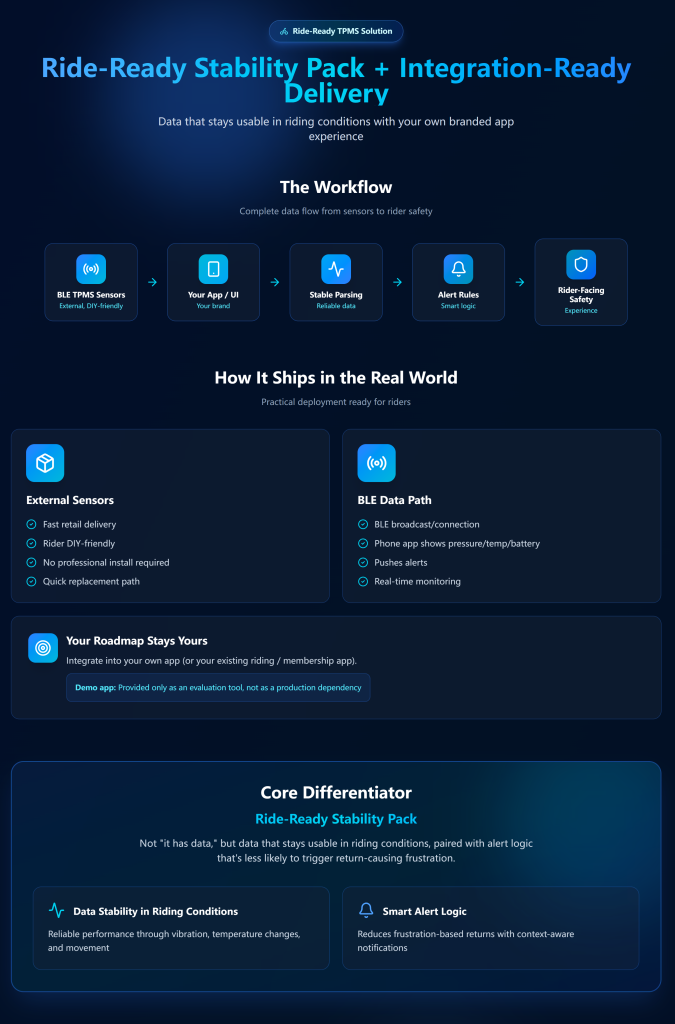
Solution: Ride-Ready Stability Pack + Integration-Ready Delivery
The workflow
BLE TPMS sensors → your app / UI → stable parsing → alert rules → rider-facing safety experience
How it ships in the real world
- External sensors: fast retail delivery, rider DIY-friendly
- BLE data path: BLE broadcast/connection → phone app shows pressure/temp/battery and pushes alerts
- Your roadmap stays yours: integrate into your own app (or your existing riding / membership app). A demo app can be provided only as an evaluation tool, not as a production dependency.
Core differentiator
Ride-Ready Stability Pack
Not “it has data,” but data that stays usable in riding conditions, paired with alert logic that’s less likely to trigger return-causing frustration.
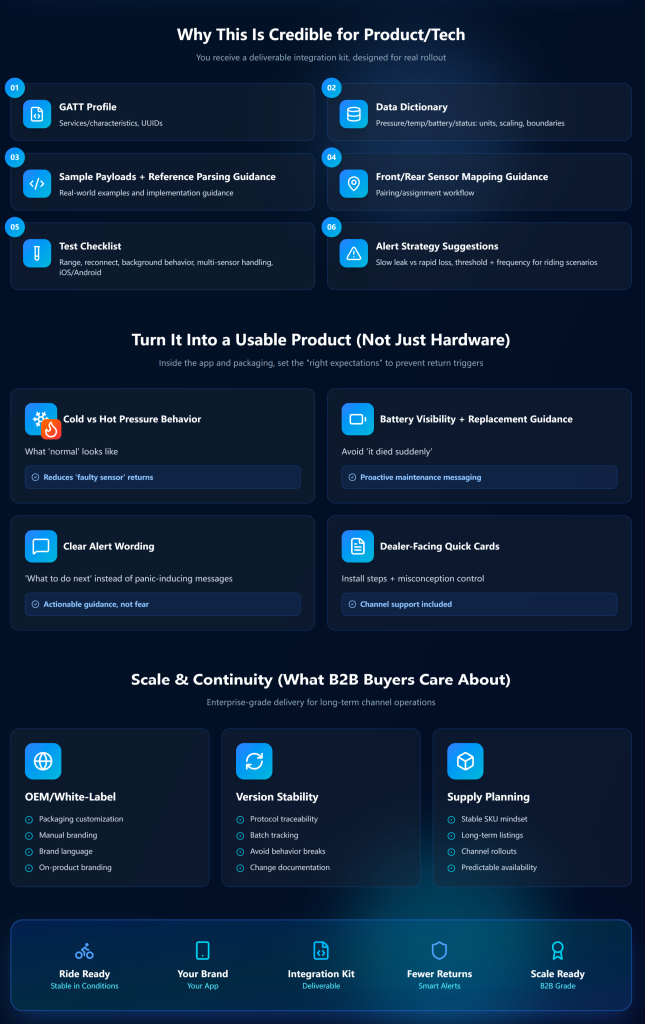
INTEGRATION KIT – DELIVERABLE CHECKLIST
To reduce engineering uncertainty, we provide integration-ready reference materials your team can validate and ship with:
- BLE Manufacturer Data advertising payload specification
(field layout, byte length, and example broadcast payload) - Data dictionary & scaling rules
(pressure, temperature, battery level, leak status — units, calculation methods, and boundary values) - Example payload decoding & parsing reference
(how to extract pressure, temperature, battery, and status from broadcast data) - Multi-sensor binding & wheel-position mapping guidance
(pairing logic based on BLE address prefix and device ID, including replacement and rebind scenarios) - Broadcast behavior & control logic reference
(stationary vs moving intervals, configurable parameters, and fast-leak trigger behavior) - iOS background scanning note
(UUID-based filtering for capturing TPMS broadcast data in background)
For a production example, review the V101M external BLE TPMS sensor, including its communication method, pressure range, operating conditions, and sample-order information.
Turn it into a usable product (not just hardware)
Inside the app and packaging, you can set the “right expectations” to prevent return triggers:
- Cold vs hot pressure behavior (what “normal” looks like)
- Battery visibility + replacement guidance (avoid “it died suddenly”)
- Clear alert wording: “what to do next” instead of panic-inducing messages
- Dealer-facing quick cards: install steps + misconception control
Scale & continuity (what B2B buyers care about)
- OEM/white-label: packaging, manual, brand language, on-product branding
- Version stability: protocol/batch traceability to avoid “new batch breaks behavior”
- Supply planning: stable SKU mindset for long-term listings and channel rollouts
BLE TPMS Integration Architecture
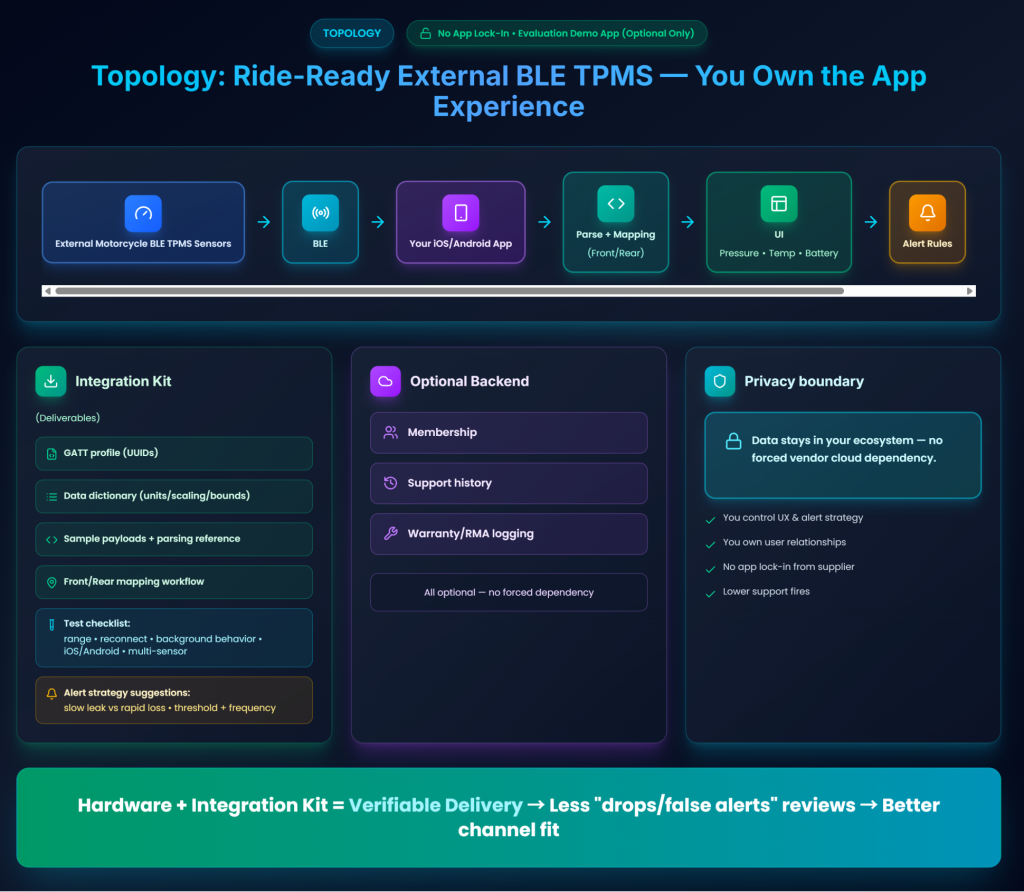
- Device: external motorcycle BLE TPMS sensors
- Communication: BLE broadcast/connection → iOS/Android
- Your app: scan/connect/parse → UI + alerts (you control UX and data)
- Optional backend: membership, support history, warranty/RMA logging
- Privacy boundary: data stays in your ecosystem; no forced vendor cloud dependency
Benefits
- Easier to sell safety value: touring/highway/mountain heat/slow leak stories convert better than raw specs
- Lower return & review risk: stable readings + controllable alerts + battery visibility reduce “drops/false alarm” complaints
- Brand asset, not a commodity: you own app + user relationship, enabling membership and cross-sell
- Channel confidence: clearer selling script + fewer RMAs → distributors and dealers push it more
- Better dealer handover: on-site validation + clear guidance reduces rework and arguments
From Sample Evaluation to OEM Production
- You own the app: no lock-in, no forced supplier app, no “data trapped elsewhere”
- Integration-first delivery: documentation + payload samples + checklist built for production rollout
- Motorcycle risk-control mindset: guidance that reduces misunderstanding-driven returns
- Batch/version discipline: stable SKU + traceability to protect listings and channel trust
OEM/white-label ready: packaging/manual/branding for differentiation (not spec wars)
Branding, packaging, documentation, sample approval, and production planning can be confirmed through Drove West’s OEM and private-label program.
BANNER.png "car tpms 3 安装渠道(轮胎店 维修连锁 改装店)banner - Drove West OBDII Scanner")

BANNER.png "car tpms 1 aftermarket 零售品牌 dtc 电商品牌(卖给车主)banner - Drove West OBDII Scanner")
 English